The real Sobeys customer survey starts at one address: www.sobeys.com/mysobeys, which forwards to Sobeys’ survey page on ca1.voxco.com. You get there from a survey invitation on a receipt or in an email. It asks for receipt details and your contact information, and it never asks you to pay anything. If a message about a survey or prize comes by text, pop-up or social media ad and asks for a fee, card details or gift card codes, it’s a scam.
This page explains how the real survey works, the warning signs of fakes, and what to do if you’ve already clicked or paid.
How does the real Sobeys survey work?
Knowing what the real survey looks like is the easiest way to spot a fake one. Based on published contest summaries for the 2026 contest:
- Where it starts: a receipt from a participating store, or an email invitation. Canadian Free Stuff notes the contest “may not be available at every Sobeys store in Canada.”
- Where you go: www.sobeys.com/mysobeys. You type it in yourself. When we checked on October 22, 2026, it forwarded to a page on ca1.voxco.com titled “Customer Satisfaction,” which opens with “Welcome / Bienvenue!” Voxco is a survey software company.
- Official contact: the survey pages list consumer.research@sobeys.com for technical issues.
- What it asks for: your language (English or French), your store, the store number, the transaction (TRANS) number and the visit date from your receipt, then your feedback.
- How you enter the contest: by giving your name and contact details and accepting the rules at the end.
- What you can win: Sobeys gift cards. Contest Scoop lists prizes of $500 in gift cards each (five $100 cards) for the 2026 contest.
- When winners are picked: by random draw after the contest closes. Contest Scoop gives October 31, 2026 as the end date and a draw on or around November 10, 2026. Winners are notified within 14 days of the draw.
Notice what’s missing from that list. The real survey doesn’t tell you that you’ve already won. It doesn’t ask for a payment, your card number, your PIN, your Social Insurance Number or a gift card code.
For the receipt details, see where to find the survey code on a Sobeys receipt.
What are the warning signs of a fake survey?
1. You’ve “already won”
The real contest is a random draw held after the contest closes. A message that says you’ve won before you’ve done a survey, or right after a three-question quiz, isn’t from Sobeys. The Canadian Anti-Fraud Centre (CAFC) says prize scams tell people they “have won, or have a chance at winning, a prize,” often by email, mail, phone, social media or website pop-ups.
2. You have to pay to get the prize
This is the clearest sign. The CAFC says that when people respond to a prize scam, they’re told they must pay an advance fee or buy something before getting their winnings, and that “no winnings are ever received.” A real contest prize doesn’t come with a shipping fee, tax payment or “processing” charge.
3. They want gift cards, e-transfers or wire transfers
The CAFC says prize scammers often ask for payment through money transfer services such as Western Union or MoneyGram, or through prepaid gift cards. The Financial and Consumer Services Commission of New Brunswick (FCNB) puts it plainly: “A company, utility, or government department will never ask you to make a payment by gift card.”
4. The link isn’t the real survey address
Fake survey pages use domain names that look close to the real one. They add words like “survey,” “mysobeys,” “rewards” or “canada,” use extra hyphens, or end in something other than .com. Check the domain in the address bar.
The real survey has two addresses you’ll see: www.sobeys.com/mysobeys, where you start, and ca1.voxco.com, where it sends you. Any other domain asking for your receipt details should make you stop. Starting at sobeys.com yourself is the safest way to make sure the redirect is the real one.
Plenty of independent guide websites, including this one, have “sobeys” in their names. A guide can explain the survey, but only sobeys.com can take your entry. If any site other than the real survey asks for your receipt numbers to “enter,” don’t use it.
5. It came by text message or a pop-up
The CAFC’s phishing guidance says: “Don’t click on links from unsolicited messages.” Its examples include texts offering a “$500 one-time payment” with a link. A text with a Sobeys gift card offer and a link fits the same pattern.
6. It asks for personal or financial details
The real survey needs your name and contact details to enter you in the draw. It doesn’t need your:
- debit or credit card number
- PIN or online banking password
- Social Insurance Number
- Scene+ password
- gift card numbers or PINs
7. Pressure to act right now
Countdown timers, “only 3 prizes left” and “claim within 10 minutes” are designed to stop you from thinking it through. The CAFC lists urgency as a common phishing lure. The real contest has a fixed period. For 2026, Contest Scoop gives August 2 to October 31.
8. Spelling mistakes and odd branding
The CAFC advises watching for spelling mistakes. It also warns not to trust a message just because the sender’s address looks real, since “fraudsters can spoof the address.” A Sobeys logo on a page proves nothing.
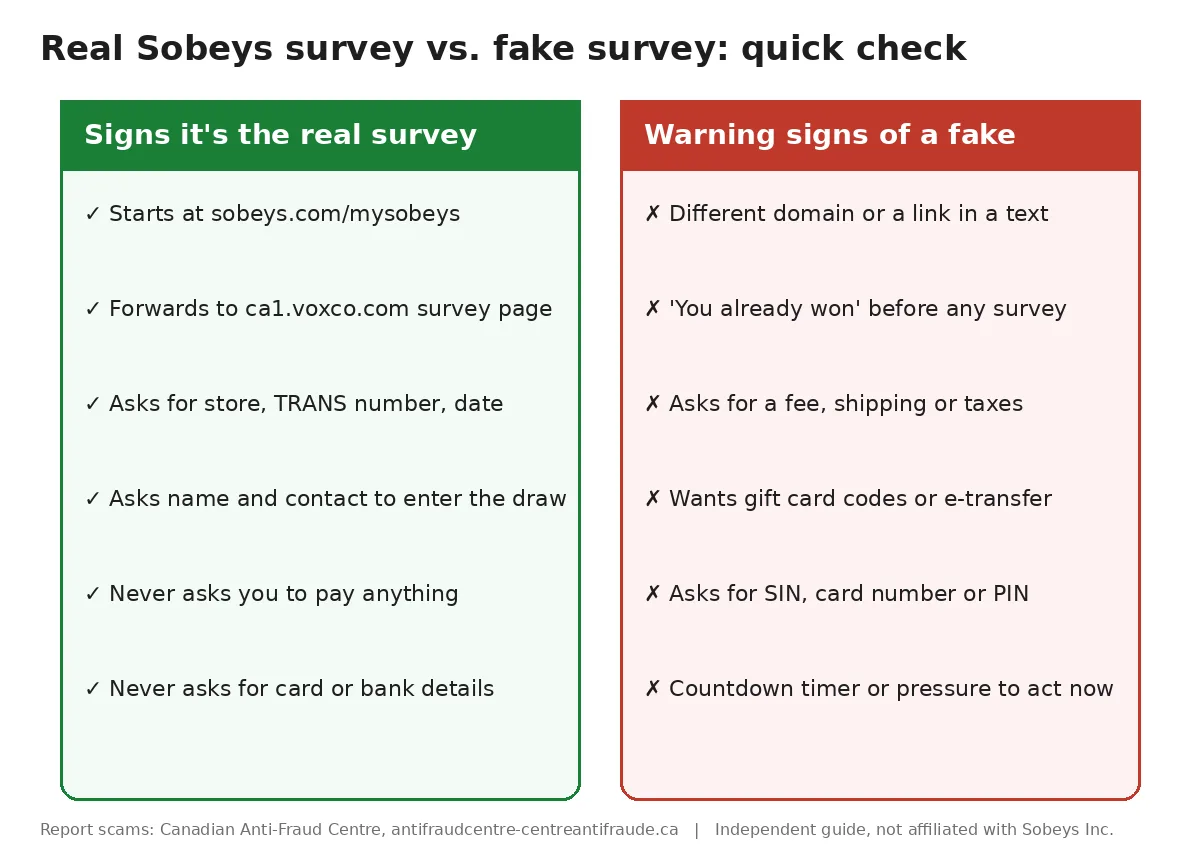
Real vs. fake: side by side
| Real Sobeys survey | Fake survey or prize scam |
|---|---|
| Starts from your receipt or an email invitation | Starts from a text, pop-up or social media ad |
| Starts at sobeys.com/mysobeys, then forwards to ca1.voxco.com | Look-alike domain or shortened link |
| Asks for store number, TRANS number and date | Asks a few quick questions, then says you won |
| Winners picked by random draw after the contest ends | “Congratulations, you’re a winner” right away |
| Free to enter, with a no-purchase option | Asks for a fee, shipping or taxes |
| Asks for name and contact details | Asks for card number, PIN, SIN or gift card codes |
How can you check a link before you tap it?
You can often see where a link really goes without opening it:
- On a phone: press and hold the link. Most phones show a preview of the full web address. If the preview isn’t sobeys.com, don’t open it.
- On a computer: hover the mouse over the link and look at the address in the bottom corner of the browser.
- Shortened links (bit.ly and similar) hide the real address. Treat a shortened link in an unexpected prize message as a warning sign.
- Safest option: skip the link completely. Type www.sobeys.com/mysobeys into your browser yourself.
Help older relatives spot these messages
The CAFC notes that some prize scams, such as fake “prize winner” calls, target seniors. If a parent or grandparent shops at Sobeys, share three simple rules with them. Real prizes never cost money. A surprise text with a link to “claim” a prize is a red flag. When in doubt, call a family member before doing anything. A two-minute call to check can save real money.
What if you already clicked, entered details or paid?
Act quickly. What to do depends on what you shared:
- Card number or banking details: call your bank or card issuer right away, using the number on the back of your card, and ask them to block the card.
- Paid with gift cards: contact the company that issued the gift card as soon as possible and give them the card numbers. Keep the cards and your receipts.
- Passwords: change the password on that account and on any other account where you used the same one. Turn on two-step verification where you can.
- Social Insurance Number: contact Service Canada. Watch your credit reports with Equifax Canada and TransUnion Canada for accounts you didn’t open.
- Clicked but entered nothing: close the page, don’t download anything it offers, and delete the message.
How do you report a fake survey?
- Canadian Anti-Fraud Centre: report online through the CAFC’s reporting system at antifraudcentre-centreantifraude.ca. The CAFC also says to report phishing messages and then delete them.
- Local police: if you lost money, report it to your local police or the RCMP. FCNB recommends contacting both the CAFC and local police.
- Spam texts: most Canadian carriers let you forward spam texts to 7726 (spells “SPAM” on a keypad).
- Sobeys: tell Sobeys customer service that someone is using its name, so it can warn other shoppers.
- Social media: report fake pages and ads to the platform.
Even if you didn’t lose money, a report helps the CAFC track how the scam is spreading.
How do you enter the real contest safely?
- Shop at a participating store and keep your receipt.
- Within a few days, type www.sobeys.com/mysobeys into your browser.
- Enter the store number, TRANS number and date, then complete the survey.
- Enter your name and contact details and accept the rules.
- If you can’t make a purchase, use the no-purchase method in the official rules. Our eligibility and rules guide explains it.
If the survey gives you trouble, see Sobeys survey not working: fixes for common errors.
Common questions
Is the Sobeys survey legit?
Yes. The survey you reach from sobeys.com/mysobeys is Sobeys’ own customer feedback survey, hosted on ca1.voxco.com, and contest listings describe gift card prizes awarded by random draw. Copies on other websites are not.
I got a text saying I won a Sobeys gift card. Is it real?
Treat it as a scam. Real winners are contacted after the draw, using the details they gave when they entered. An unexpected text with a link is the pattern the CAFC warns about. Don’t click it. Report it, then delete it.
Would Sobeys ask me to pay shipping for a prize?
A prize that needs a payment before you get it is the classic sign of a prize scam, according to the CAFC.
How are real winners contacted?
Contest Scoop says winners are notified within 14 days of the draw, using the contact details they gave when they entered. See Sobeys survey winners and draw process.
Sources: Canadian Anti-Fraud Centre, prize scams; Canadian Anti-Fraud Centre, phishing; FCNB, gift card scams; Consumer Protection BC, forwarding spam texts to 7726; Contest Scoop, Sobeys My Sobeys contest; Canadian Free Stuff, My Sobeys contest. This site is an independent guide and is not run by or affiliated with Sobeys Inc.